
Human Adaptation Map
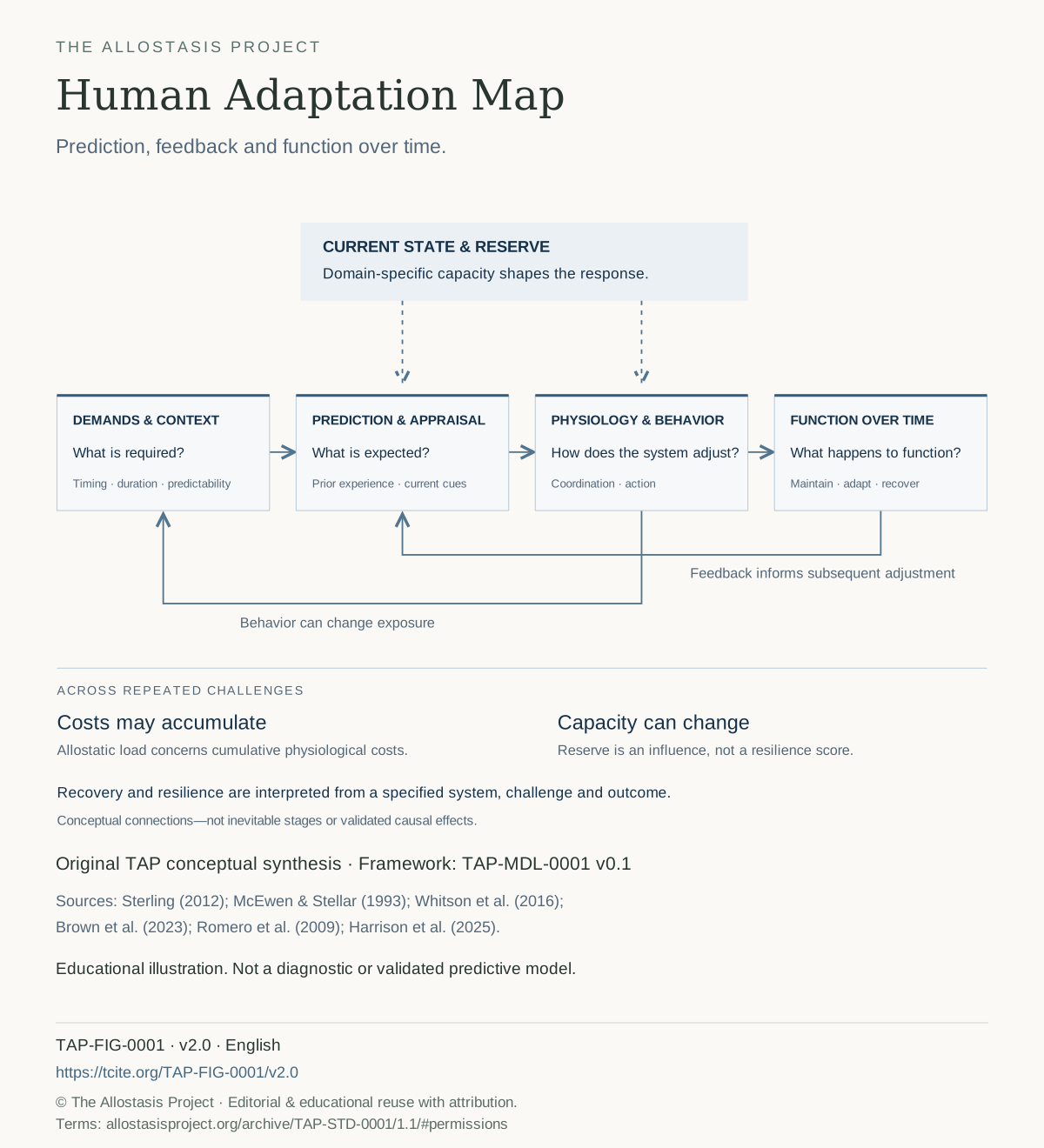
Demands, predictive regulation and function over time, connected by feedback and shaped by current state and reserve.
Updated 2026-09-16 · Archived
This is the text and publication record captured for this edition. Later corrections appear in subsequent editions. Website design and interactive software are not archived here.
Reading the map
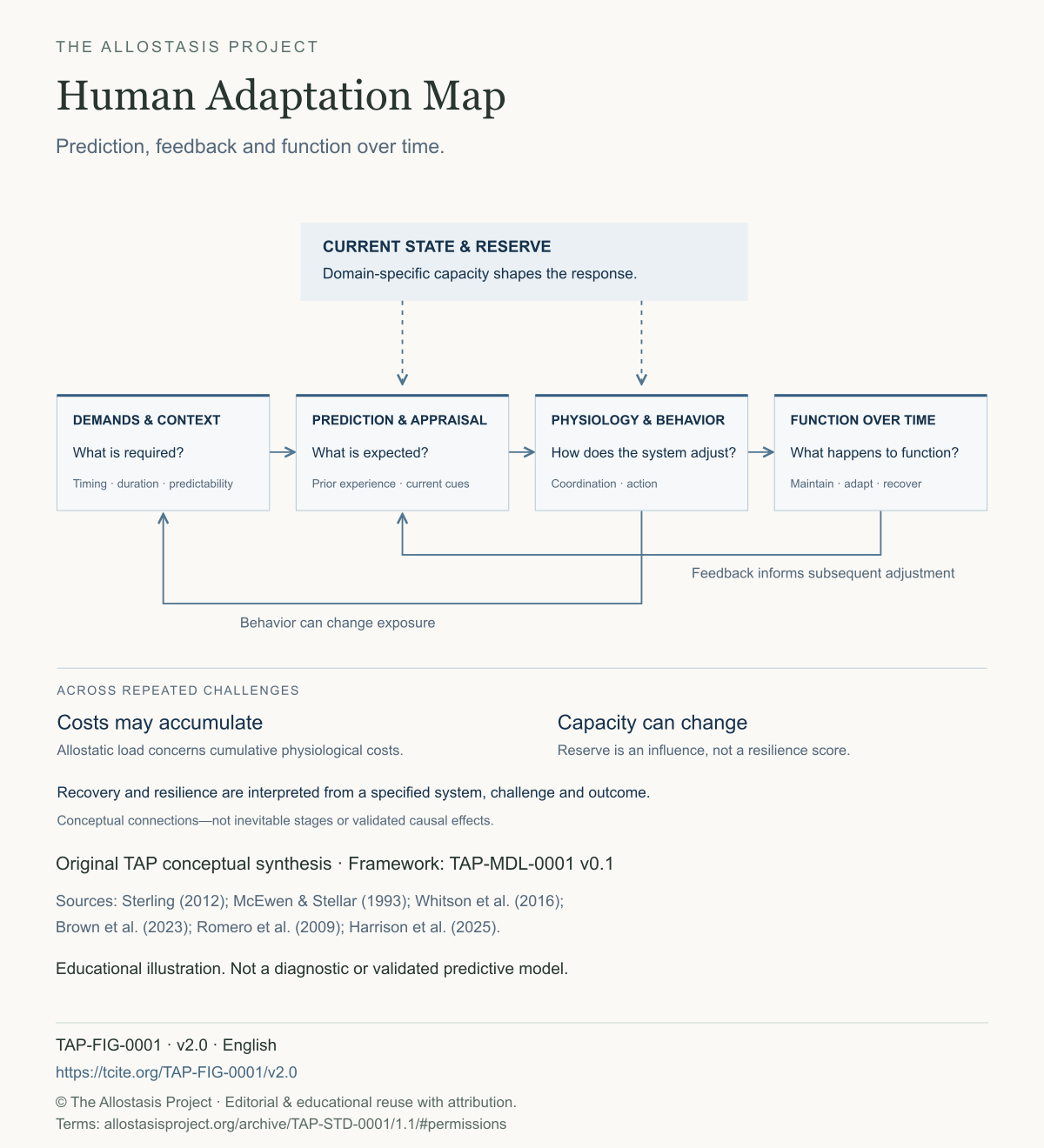
Prediction and appraisal connect current cues and prior experience to physiological and behavioral adjustment. Observed outcomes inform subsequent adjustment, while behavior can change exposure. Current state and domain-specific reserve influence the response; reserve is not a final stage in a fixed sequence.[1][3][6]
Function is observed over a defined interval, in a specified system and challenge. Recovery and resilience are interpreted from those observations; neither is a universally favorable curve shape. Across challenges, cumulative costs and capacity may change. All demands do not cause damage, and a single slow-decaying signal does not measure allostatic load.[2][4][5]
Scope & attribution
This original TAP educational synthesis is the overview figure for TAP Human Adaptation Framework (TAP-MDL-0001 v0.1). The arrows express conceptual connections, not inevitable stages, quantified effects or validated causal pathways. It is not a diagnostic model or personal score. Source theories remain attributable to their original authors; citation does not imply their endorsement.
This marked edition permits attributed reuse in editorial reporting, teaching and noncommercial presentations under the linked TAP permission. Retain the source, identifier, version and scope notes; advertising, product marketing, paid asset resale and adaptations need separate permission.
What changed in v2.0
Replaced the stage-like arrangement with predictive regulation and feedback. Separated regulatory response from function, positioned reserve as an influence and added behavioral effects on exposure. Earlier editions remain in the archive. This conceptual revision does not indicate completed scientific review.
Figure specification
tap-adaptation-map/2.0; original conceptual synthesis; demands/context -> prediction/appraisal -> physiology/behavior -> function over time; feedback from function to prediction; behavior to exposure; current state/reserve influence regulation; cumulative costs and capacity change across challenges. Associated framework: TAP-MDL-0001 v0.1.
References
- Peter Sterling (2012). Allostasis: a model of predictive regulation. Physiology & Behavior. https://doi.org/10.1016/j.physbeh.2011.06.004
- Bruce S. McEwen, Eliot Stellar (1993). Stress and the individual. Mechanisms leading to disease. Archives of Internal Medicine. https://doi.org/10.1001/archinte.1993.00410180039004
- Heather E. Whitson, Wei Duan-Porter, Kenneth E. Schmader, Miriam C. Morey, Harvey J. Cohen, Cathleen S. Colón-Emeric (2016). Physical Resilience in Older Adults: Systematic Review and Development of an Emerging Construct. The Journals of Gerontology: Series A. https://doi.org/10.1093/gerona/glv202
- LaVerne Brown, Barbara Cohen, Rebecca Costello, Olga Brazhnik, Zorina Galis (2023). Conceptualizing a resilience research framework at The National Institutes of Health. Stress and Health. https://doi.org/10.1002/smi.3260
- L. Michael Romero, Molly J. Dickens, Nicole E. Cyr (2009). The Reactive Scope Model — A new model integrating homeostasis, allostasis, and stress. Hormones and Behavior. https://doi.org/10.1016/j.yhbeh.2008.12.009
- Laura A. Harrison, Antonio J. Gracias, Karl J. Friston, J. Galen Buckwalter (2025). Resilience phenotypes derived from an active inference account of allostasis. Frontiers in Behavioral Neuroscience. https://doi.org/10.3389/fnbeh.2025.1524722
Publication record
TAP-FIG-0001 · v2.0 · English
The Allostasis Project is founded and supported by Resilio.
© The Allostasis Project. Reuse with attribution is permitted in editorial reporting, teaching and noncommercial presentations under the TAP permission. Advertising, product marketing, paid asset resale and adaptations require separate permission. Legal exceptions remain unaffected.