
Explore the project
ARCHIVED EDITION · TAP-FIG-0002 · v1.1 · EnglishTAP Record & current edition ↗

Recovery trajectories

An adjustable illustration of response size, settling speed and overlapping responses.

Updated 2026-09-14 · Archived

Reuse ↗
THE ALLOSTASIS PROJECT

Cite this work

TAP publication · cite this edition for our explanation.

Publication record
Work identifier
TAP-FIG-0002
Edition
v1.1 · English
Updated
2026-09-14
Archived

TAP Record ↗ · Read this edition ↗

Available editions: v1.1v1.0

This is the text and publication record captured for this edition. Later corrections appear in subsequent editions. Website design and interactive software are not archived here.
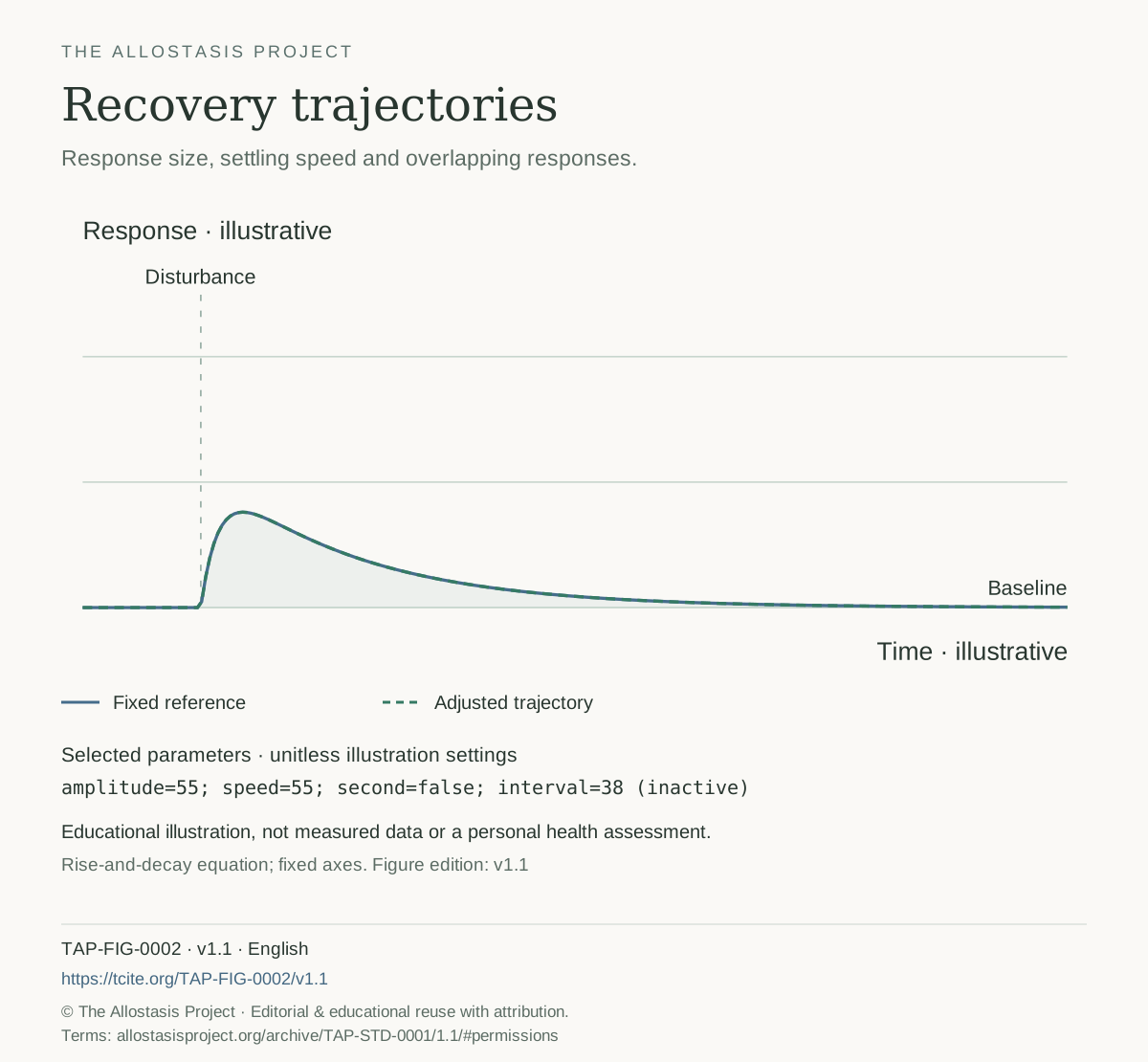
An adjustable illustration of response size, settling speed and overlapping responses.
Download figureSVG ↧PNG ↧Permission policy ↗© The Allostasis Project. Reuse with attribution is permitted in editorial reporting, teaching and noncommercial presentations under the TAP permission. Advertising, product marketing, paid asset resale and adaptations require separate permission. Legal exceptions remain unaffected.

Reading the curves

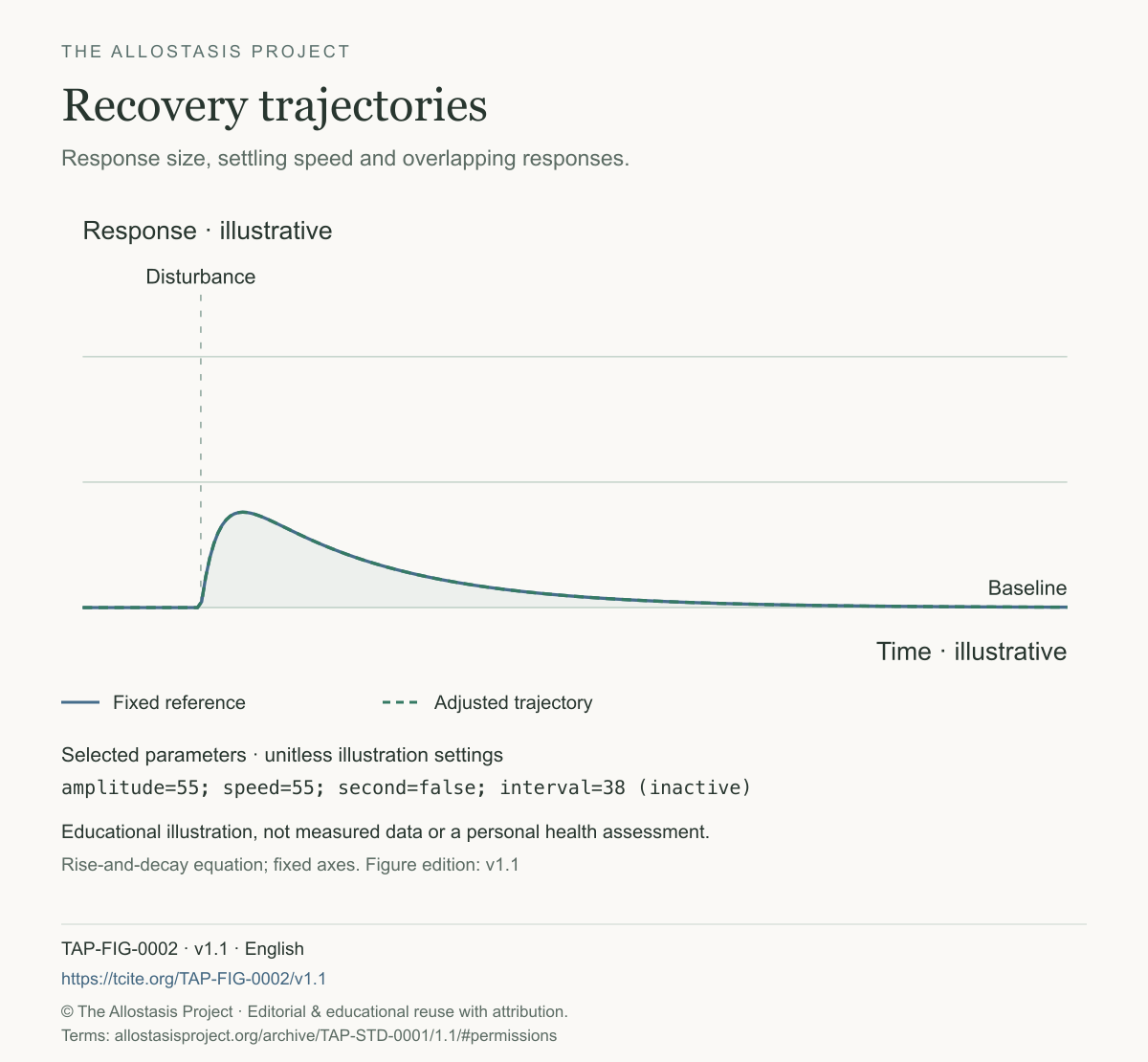
The blue line is a fixed reference. The dashed green line responds to changes in response size, settling speed and the timing of a second disturbance. Compare one setting at a time. Axes remain fixed so that scale changes do not hide differences.

These curves are generated from a simple rise-and-decay equation, not fitted to biological data. Adding a second mathematical response illustrates overlap; it is not a rule for adding real-life demands. The diagram does not estimate health, recovery time or physiological reserve. A smaller response or faster return is not necessarily better in every biological context.

A reproducible illustration

The archived SVG and PNG show the default scenario. A download from the interactive explorer records the selected parameters, model version and source. Parameter values are unitless illustration settings, not physiological measurements or recommendations.

Custom scenarios are generated locally in your browser and are not deposited as individual archived editions. To identify a custom image, retain its parameter line alongside the figure citation. The archive preserves the default illustration, equation and source text, not a historical copy of the entire interactive website.

Figure specification

tap-recovery/1.0; t=0..100; onset=12; r(s)=s<=0?0:(a/100)*(1-exp(-s/2))*exp(-s/(5+(100-v)*0.22)); second response at 12+i if enabled; fixed axes; default a=55,v=55,i=38,second=false

Download this edition’s model source ↧

Publication record

TAP-FIG-0002 · v1.1 · English

The Allostasis Project is founded and supported by Resilio.

© The Allostasis Project. Reuse with attribution is permitted in editorial reporting, teaching and noncommercial presentations under the TAP permission. Advertising, product marketing, paid asset resale and adaptations require separate permission. Legal exceptions remain unaffected.

Download complete edition record (JSON) ↧

Record integrity & available editions

SHA-256: 36976729f699ece68dc973732010bb91b40e29755008178887594b26f2331fef

Captured: 2026-09-14T09:45:24.921Z

Start with a question.

Enter a keyword to search this site.

ExploreQuestions about Human AdaptationExploreMeasurement & InterpretationReading guide · Essential 5Allostatic LoadReading guide · Essential 5Recovery ScienceReading guide · Essential 5Reserve & ResilienceReading guide · Essential 5MeasurementFoundationsLoadFoundationsAllostasisFoundationsRecoveryFoundationsAllostatic LoadFoundationsPhysiological ReserveFoundationsResilienceFeaturesAllostatic Load: The Hidden Cost of AdaptationFeaturesRecovery Is Not RestFeaturesModels of Adaptation: What Different Frameworks ExplainFeaturesTAP Human Adaptation FrameworkFeaturesAre Recovery and Resilience the Same Thing?FeaturesDoes Recovery Always Mean Returning to the Same Baseline?FeaturesHow Are Physiological Reserve and Resilience Related?FeaturesWhat Can HRV Tell Us About Recovery?FeaturesWhy Feeling Better Doesn’t Always Mean Fully RecoveredMethods & projectEvidence grading & methodsMethods & projectEditorial & scientific standardsMethods & projectAbout the projectResearch · 1993Stress and the individual. Mechanisms leading to diseaseResearch · 1998Protective and damaging effects of stress mediatorsResearch · 2003The cumulative cost of additional wakefulness: dose-response effects on neurobehavioral functions and sleep physiology from chronic sleep restriction and total sleep deprivationResearch · 2006The perseverative cognition hypothesis: a review of worry, prolonged stress-related physiological activation, and healthResearch · 2007The Recovery Experience Questionnaire: development and validation of a measure for assessing recuperation and unwinding from workResearch · 2009The Reactive Scope Model — A new model integrating homeostasis, allostasis, and stressResearch · 2010Neurobehavioral dynamics following chronic sleep restriction: dose-response effects of one night for recoveryResearch · 2010Greater cardiovascular responses to laboratory mental stress are associated with poor subsequent cardiovascular risk status: a meta-analysis of prospective evidenceResearch · 2010Allostatic load biomarkers of chronic stress and impact on health and cognitionResearch · 2011Stress- and Allostasis-Induced Brain PlasticityResearch · 2012Allostasis: a model of predictive regulationResearch · 2013The LF/HF ratio does not accurately measure cardiac sympatho-vagal balanceResearch · 2013Effects of recovery sleep after one work week of mild sleep restriction on interleukin-6 and cortisol secretion and daytime sleepiness and performanceResearch · 2014Clarifying the roles of homeostasis and allostasis in physiological regulationResearch · 2014Resilience definitions, theory, and challenges: interdisciplinary perspectivesResearch · 2015Recovery from job stress: The stressor-detachment model as an integrative frameworkResearch · 2016Physiological concomitants of perseverative cognition: A systematic review and meta-analysisResearch · 2016Physical Resilience in Older Adults: Systematic Review and Development of an Emerging ConstructResearch · 2017Heart Rate Variability and Cardiac Vagal Tone in Psychophysiological Research - Recommendations for Experiment Planning, Data Analysis, and Data ReportingResearch · 2017A Meta-Analysis on Antecedents and Outcomes of Detachment from WorkResearch · 2018Recovery and Performance in Sport: Consensus StatementResearch · 2019Ad libitum Weekend Recovery Sleep Fails to Prevent Metabolic Dysregulation during a Repeating Pattern of Insufficient Sleep and Weekend Recovery SleepResearch · 2019Resilience in Clinical Care: Getting a Grip on the Recovery Potential of Older AdultsResearch · 2020Whitepaper: Defining and investigating cognitive reserve, brain reserve, and brain maintenanceResearch · 2021Leaving Work at Work: A Meta-Analysis on Employee Recovery From WorkResearch · 2022"Give me a break!" A systematic review and meta-analysis on the efficacy of micro-breaks for increasing well-being and performanceResearch · 2022Allostatic Load Measurement: A Systematic Review of Reviews, Database Inventory, and Considerations for Neighborhood ResearchResearch · 2022Allostatic Load and Mortality: A Systematic Review and Meta-AnalysisResearch · 2022Recovery from Work: Advancing the Field Toward the FutureResearch · 2023Conceptualizing a resilience research framework at The National Institutes of HealthResearch · 2023Towards a consensus definition of allostatic load: a multi-cohort, multi-system, multi-biomarker individual participant data (IPD) meta-analysisResearch · 2024Impact of baseline and longitudinal allostatic load changes on incident cardiovascular disease and all-cause mortality: A 7-year population-based cohort study in ChinaResearch · 2025Resilience phenotypes derived from an active inference account of allostasisResearch · 2026Building an ontology of resilience: Insights from the physical resilience literatureTAP Record · TAP-CON-0001LoadTAP Record · TAP-CON-0002AllostasisTAP Record · TAP-CON-0003RecoveryTAP Record · TAP-CON-0004Allostatic LoadTAP Record · TAP-CON-0005Physiological ReserveTAP Record · TAP-CON-0006ResilienceTAP Record · TAP-FTR-0001Allostatic Load: The Hidden Cost of AdaptationTAP Record · TAP-FTR-0002Recovery Is Not RestTAP Record · TAP-FTR-0008Models of Adaptation: What Different Frameworks ExplainTAP Record · TAP-MDL-0001TAP Human Adaptation FrameworkTAP Record · TAP-FTR-0006Are Recovery and Resilience the Same Thing?TAP Record · TAP-FTR-0007Does Recovery Always Mean Returning to the Same Baseline?TAP Record · TAP-FTR-0004How Are Physiological Reserve and Resilience Related?TAP Record · TAP-FTR-0005What Can HRV Tell Us About Recovery?TAP Record · TAP-FTR-0003Why Feeling Better Doesn’t Always Mean Fully RecoveredTAP Record · TAP-RDN-0001TAP reading note: Stress and the individual. Mechanisms leading to diseaseTAP Record · TAP-RDN-0002TAP reading note: Protective and damaging effects of stress mediatorsTAP Record · TAP-RDN-0003TAP reading note: The cumulative cost of additional wakefulness: dose-response effects on neurobehavioral functions and sleep physiology from chronic sleep restriction and total sleep deprivationTAP Record · TAP-RDN-0016TAP reading note: The perseverative cognition hypothesis: a review of worry, prolonged stress-related physiological activation, and healthTAP Record · TAP-RDN-0020TAP reading note: The Recovery Experience Questionnaire: development and validation of a measure for assessing recuperation and unwinding from workTAP Record · TAP-RDN-0032TAP reading note: The Reactive Scope Model — A new model integrating homeostasis, allostasis, and stressTAP Record · TAP-RDN-0024TAP reading note: Neurobehavioral dynamics following chronic sleep restriction: dose-response effects of one night for recoveryTAP Record · TAP-RDN-0004TAP reading note: Greater cardiovascular responses to laboratory mental stress are associated with poor subsequent cardiovascular risk status: a meta-analysis of prospective evidenceTAP Record · TAP-RDN-0013TAP reading note: Allostatic load biomarkers of chronic stress and impact on health and cognitionTAP Record · TAP-RDN-0005TAP reading note: Stress- and Allostasis-Induced Brain PlasticityTAP Record · TAP-RDN-0006TAP reading note: Allostasis: a model of predictive regulationTAP Record · TAP-RDN-0018TAP reading note: The LF/HF ratio does not accurately measure cardiac sympatho-vagal balanceTAP Record · TAP-RDN-0026TAP reading note: Effects of recovery sleep after one work week of mild sleep restriction on interleukin-6 and cortisol secretion and daytime sleepiness and performanceTAP Record · TAP-RDN-0012TAP reading note: Clarifying the roles of homeostasis and allostasis in physiological regulationTAP Record · TAP-RDN-0029TAP reading note: Resilience definitions, theory, and challenges: interdisciplinary perspectivesTAP Record · TAP-RDN-0007TAP reading note: Recovery from job stress: The stressor-detachment model as an integrative frameworkTAP Record · TAP-RDN-0017TAP reading note: Physiological concomitants of perseverative cognition: A systematic review and meta-analysisTAP Record · TAP-RDN-0008TAP reading note: Physical Resilience in Older Adults: Systematic Review and Development of an Emerging ConstructTAP Record · TAP-RDN-0019TAP reading note: Heart Rate Variability and Cardiac Vagal Tone in Psychophysiological Research - Recommendations for Experiment Planning, Data Analysis, and Data ReportingTAP Record · TAP-RDN-0009TAP reading note: A Meta-Analysis on Antecedents and Outcomes of Detachment from WorkTAP Record · TAP-RDN-0010TAP reading note: Recovery and Performance in Sport: Consensus StatementTAP Record · TAP-RDN-0025TAP reading note: Ad libitum Weekend Recovery Sleep Fails to Prevent Metabolic Dysregulation during a Repeating Pattern of Insufficient Sleep and Weekend Recovery SleepTAP Record · TAP-RDN-0027TAP reading note: Resilience in Clinical Care: Getting a Grip on the Recovery Potential of Older AdultsTAP Record · TAP-RDN-0028TAP reading note: Whitepaper: Defining and investigating cognitive reserve, brain reserve, and brain maintenanceTAP Record · TAP-RDN-0022TAP reading note: Leaving Work at Work: A Meta-Analysis on Employee Recovery From WorkTAP Record · TAP-RDN-0023TAP reading note: "Give me a break!" A systematic review and meta-analysis on the efficacy of micro-breaks for increasing well-being and performanceTAP Record · TAP-RDN-0011TAP reading note: Allostatic Load Measurement: A Systematic Review of Reviews, Database Inventory, and Considerations for Neighborhood ResearchTAP Record · TAP-RDN-0015TAP reading note: Allostatic Load and Mortality: A Systematic Review and Meta-AnalysisTAP Record · TAP-RDN-0021TAP reading note: Recovery from Work: Advancing the Field Toward the FutureTAP Record · TAP-RDN-0033TAP reading note: Conceptualizing a resilience research framework at The National Institutes of HealthTAP Record · TAP-RDN-0014TAP reading note: Towards a consensus definition of allostatic load: a multi-cohort, multi-system, multi-biomarker individual participant data (IPD) meta-analysisTAP Record · TAP-RDN-0031TAP reading note: Impact of baseline and longitudinal allostatic load changes on incident cardiovascular disease and all-cause mortality: A 7-year population-based cohort study in ChinaTAP Record · TAP-RDN-0034TAP reading note: Resilience phenotypes derived from an active inference account of allostasisTAP Record · TAP-RDN-0030TAP reading note: Building an ontology of resilience: Insights from the physical resilience literatureTAP Record · TAP-FIG-0001Human Adaptation MapTAP Record · TAP-FIG-0002Recovery trajectoriesTAP Record · TAP-STD-0001Citation & Reuse