
Same Biomarkers, Different Scores
How reference populations, survey weights and scoring rules change a five-marker allostatic-load index. A reproducible NHANES methods case.
Updated 2026-09-20 · Archived
This is the text and publication record captured for this edition. Later corrections appear in subsequent editions. Website design and interactive software are not archived here.
Same measurements. Different scores.
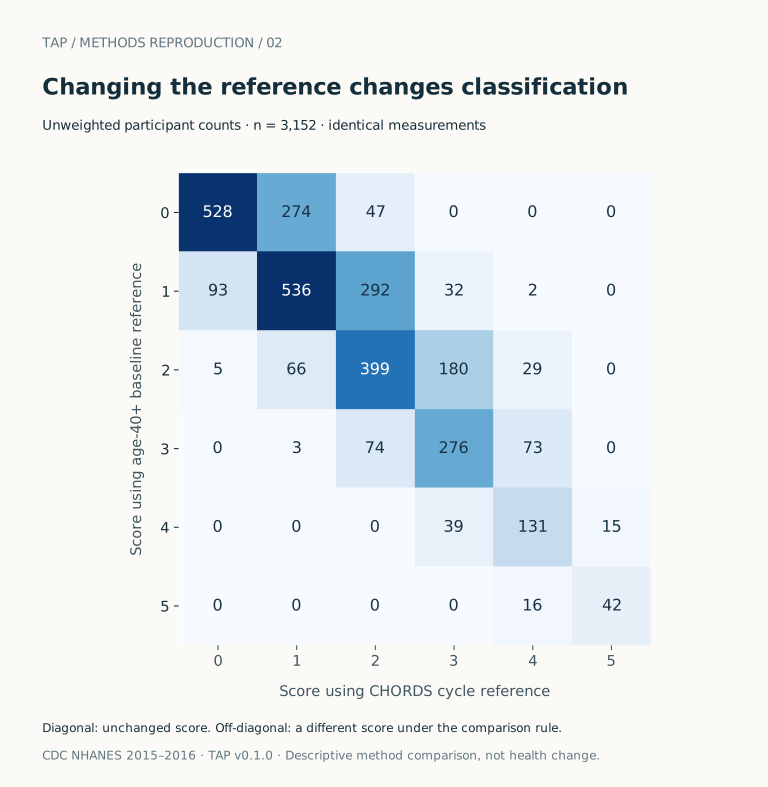
A composite index depends on the rules that produce it. In this TAP analysis, changing only the reference from adults aged 40+ to adults aged 18+ changed the total score of 758 of the same 3,152 participants (24.0%). Their measured biomarkers did not change.
We compared seven implementations of a five-marker allostatic-load index in NHANES 2015–2016. This is a descriptive methods case: it quantifies sensitivity to analytical choices, not which method is healthiest, most accurate or best at predicting an outcome.
The workflow behind this case
Beese and colleagues describe a workflow and repository for deriving an allostatic-load index from secondary datasets. We inspected the medRxiv version dated 1 August 2025 and CHORDS repository commit 2bbb624dd01cec5c54b778d3cd2df4ada582c989. The preprint and code have separate versions. The five-marker choice draws on the multi-cohort investigation by McCrory and colleagues.[1][2][4]
The results below are newly calculated by TAP. We did not reproduce the authors’ All of Us or HRS cohorts or execute their complete notebooks. The CHORDS comparator reconstructs the NHANES merge domains and scoring choices for one cycle; the other comparisons are TAP analytical choices.
Who was included—and why age 40+?
Six public CDC components were joined by the unique SEQN identifier: DEMO_I, GHB_I, HDL_I, HSCRP_I, BPX_I and BMX_I. Of 9,971 demographic records, 9,544 had a positive examination weight. Among 3,610 eligible adults aged 40+, 3,152 had all five markers and 458 did not. Every score comparison uses exactly those 3,152 complete cases.[3]
Age 40+ was chosen to align the lower age boundary broadly with the midlife and older populations examined by McCrory and colleagues. It is a transparent analytical baseline, not a universal normal range or a demonstration that age-specific thresholds are superior. The 18+ and mixed-age comparisons show how this choice matters.[2]
One survey cycle avoids overlapping-period duplication and between-cycle assay harmonisation. These historical US data do not estimate current health or provide norms for Chinese users. Complete cases cover 87.3% of eligible participants, or 90.2% of their MEC weight; missingness remains a limitation.
How the five-marker index was calculated
The markers are CRP (mg/L), HbA1c (%), HDL cholesterol (mg/dL), survey pulse (beats/minute) and waist-to-height ratio (waist and height both in cm). A point is assigned at or above the 75th percentile for four markers; HDL uses at or below the 25th percentile. The sum ranges from 0 to 5. These are sample-derived thresholds, not clinical cutoffs.
The baseline estimates each threshold from its available observations among eligible adults aged 40+, using WTMEC2YR. Weighted quantiles follow Hmisc wtd.quantile with type="quantile" and normwt=FALSE, matching the inspected upstream call. The unweighted variant uses R type-7 quantiles. This is one specified quantile convention; using weights does not remove every source of bias.[3][5]
Any missing marker or unavailable threshold leaves the total missing. CDC below-detection-limit replacements are retained, including 89 complete cases flagged for CRP. No imputation or statistical-outlier exclusion is applied. Survey pulse is not interchangeable with a wearable’s overnight resting heart rate.
Which decisions changed the score?
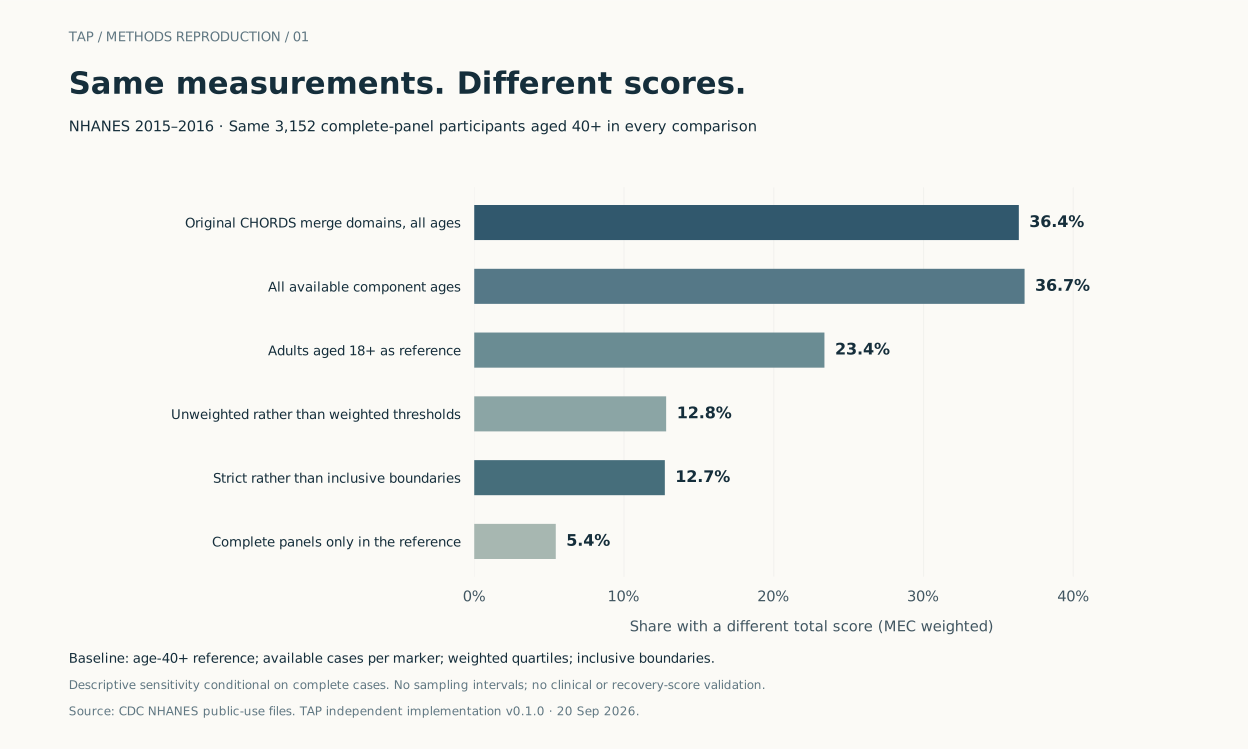
All changes below are relative to the age-40+ baseline, holding participants and their biomarker measurements fixed. “Changed” means a difference of at least one total-score point. The table gives exact sample counts and unweighted percentages; the first figure separately presents MEC-weighted percentages conditional on the same complete cases.
CHORDS cycle reference: 1,240 / 3,152 (39.3%).
All available component ages: 1,239 / 3,152 (39.3%).
Age 18+ reference: 758 / 3,152 (24.0%).
Unweighted thresholds: 483 / 3,152 (15.3%).
Strict threshold boundaries: 454 / 3,152 (14.4%).
Complete-panel reference: 203 / 3,152 (6.4%).
Why seemingly small rules matter
Treating equality differently changed 454 totals (14.4%). Discrete or rounded measurements create ties: 181 participants were exactly at the baseline HbA1c threshold, 180 at the pulse threshold and 91 at the HDL threshold; individuals may appear in more than one count. A quartile rule therefore need not flag exactly 25% of observations.
The CHORDS laboratory assembly starts with GHB and left-joins other laboratory tables; its examination assembly starts with BPX. That restricts the reference domains. We reconstructed those joins separately from a comparator using all available component ages. The two approaches are not identical, even though their rounded proportions changing score are both 39.3%.
What was independently checked
Python calculations were checked through a second XPT reader and an independent rowwise implementation. Thirty-eight CDC codebook frequency rows and 500 synthetic weighted-quantile fixtures agreed. A local pandas zero-decoding issue was identified and corrected; final analysis uses pyreadstat.
A further check used native R 4.6.1, foreign 0.8.91 and unmodified Hmisc 5.3-0 weighted-statistics functions from the checksum-verified CRAN source release. R independently read the six original XPT files, reconstructed reference domains and calculated all scores. All 35 thresholds, 22,064 participant-by-variant scores and seven aggregate comparisons agreed within the stated numerical tolerances.
Hmisc functions and their helpers were executed directly in R; its full package and the complete CHORDS notebooks were not run. Computational agreement is evidence about implementation, not construct validity, clinical utility or completed human scientific review.
What this analysis cannot establish
MEC-weighted summaries are conditional on participants with a complete panel. We did not estimate design-based confidence intervals or recalibrate for item nonresponse. Complete and incomplete cases had mean released ages of 59.3 and 62.7 years, respectively; age is top-coded at 80. Selection into the complete-case sample may affect interpretation.
Medication, disease and pregnancy handling were not modelled. No clinical-cutoff or continuous-score comparator, mortality prediction, longitudinal change, diagnostic accuracy or out-of-sample validation was evaluated. The observed sensitivity cannot establish which method is preferable.
This analysis was not preregistered. Its local protocol records two implementation amendments after the initial run: correcting zero decoding and adding the CHORDS-specific merge-domain comparator. The primary evaluation population and baseline scientific rules were unchanged.
What to ask before using a score
Ask which markers and measurement conditions are included, who defines the reference, how weights and ties are handled, and what happens to missing values. A score should travel with that specification and the evidence supporting its intended use.
For TAP, this case supports making measurement choices visible and reproducible. Linking a biomarker index to event-related recovery trajectories is a separate longitudinal research question. This study supplies no conversion to a universal 0–100 resilience score.
Publication and research context
This is TAP methods case v1.0, based on analysis rules v0.1.0. Source inspection, programming, computational checking, writing and translation were AI-assisted. Named independent scientific and methods review has not been completed. The downloadable records document actual computational checks separately.
The Allostasis Project is operated by Conatus Biosciences Inc. in the United States and founded and supported by Resilio. This case evaluates no Resilio product. CDC, CHORDS and the cited researchers did not endorse this TAP analysis. Source data and software retain their own rights; TAP materials retain the rights stated in the publication record.
Data, figures & reproducible methods
Files are fixed to this edition. The package contains analysis code and aggregate results; participant-level records are not redistributed.
- Reproduction package · ZIP
SHA-256
dc265e0b6848cfd96bac7cf9e09edc75c2677f3195332d834241820420e3f353 - Method comparison · CSV
SHA-256
ce065298c2e055745b53fbd34ca82430a1d360fa91f31869ecbf14cbfbb910d2 - Reference thresholds · CSV
SHA-256
1725b7f7dab9fd66bf01ead9fed03b85e4af06988d85419a7c72895c65edc5cb - Sensitivity figure · SVG
SHA-256
ebf3dbd920b2011c0ce8a2bec3e48060e3f29eff68a60e39ee07f44e2d3f2019 - Sensitivity figure · PDF
SHA-256
fa6315d2ea89bab3ff830178b707032a41daa6e9f76914d2183af490e1134316 - Score transitions · SVG
SHA-256
991fe4306a52888512748570b25333bef8088e46fb05412588bb839d9c459957 - Score transitions · PDF
SHA-256
6088184051ec11a97b3557bdf33a9931418a517dca0aea9a14c51e27e4c6ec87
References
- Shawna Beese, J. Cross, D. Rice, T. L. DeJong (2025). Allostatic (over)Load Measurement: Workflow and repository. medRxiv (preprint). https://doi.org/10.1101/2025.07.31.25332519
- Cathal McCrory, Sinead McLoughlin, Richard Layte, Cliona NiCheallaigh, Aisling M. O’Halloran, Henrique Barros, Lisa F. Berkman, Murielle Bochud, Eileen M. Crimmins, Meagan T. Farrell, Silvia Fraga, Emily Grundy, Michelle Kelly-Irving, Dusan Petrovic, Teresa Seeman, Silvia Stringhini, Peter Vollenveider, Rose Anne Kenny (2023). Towards a consensus definition of allostatic load: a multi-cohort, multi-system, multi-biomarker individual participant data (IPD) meta-analysis. Psychoneuroendocrinology. https://doi.org/10.1016/j.psyneuen.2023.106117
- National Center for Health Statistics (2017). NHANES 2015–2016: demographic variables and sample weights. CDC NHANES. https://wwwn.cdc.gov/Nchs/Data/Nhanes/Public/2015/DataFiles/DEMO_I.htm
- CHORDS Lab (2026). Allostatic (over)Load Repository, commit 2bbb624dd01cec5c54b778d3cd2df4ada582c989. GitHub repository. https://github.com/CHORDSLab/Allostatic-over-Load-Repository/tree/2bbb624dd01cec5c54b778d3cd2df4ada582c989
- Hmisc contributors (2026). Hmisc 5.3-0: Harrell Miscellaneous. CRAN. https://cran.r-project.org/package=Hmisc
Publication record
TAP-MTH-0002 · v1.0 · English
Author: TAP Editorial Team ·
Scientific review has not been completed for this edition.
The Allostasis Project is founded and supported by Resilio.
Record for v1.0 · Updated
Editing & copyediting
No completion recordEvidence verification
No completion recordScientific review
Not yet scientifically reviewedMethods review
No completion recordAI assistance
AI-assistedTAP Research Agent
Computational checks are reported separately from human scientific or methods review.
TAP Research Agent / Codex — Source inspection · Independent analysis implementation · Numerical cross-checking · Writing and translation — Human checks have not been recorded.
v1.0
© The Allostasis Project. All rights reserved. Reproduction or adaptation requires separate permission, subject to applicable legal exceptions.
Download complete edition record (JSON) ↧
Record integrity & available editions
SHA-256: 7be9a98da04f7adda7c38207fe62ce3cf0605efa266ef6b0be434cadb8da3239
Captured: 2026-09-20T06:32:55.674Z
- v1.0 · 2026-09-20